Northern Sea Route: commercial promise, constraints and investment outlook


OWL brings deep expertise in financial and tax due diligence, with a strong track record advising investors,
Read now
Ensuring success in international mergers and acquisitions requires a deep understanding of the differences
Read now

Could the Arctic corridor become a viable alternative between Asia and Europe? Its shorter passage is attractive, but seasonal access, infrastructure gaps and geopolitical risks continue to limit its role.
A voyage from Shanghai to Rotterdam via the Northern Sea Route (NSR) can take around 35 days, compared with 48 days through the Suez Canal. This potential time saving, alongside changing Arctic sea-ice conditions, has drawn fresh attention to the route. But a shorter passage is not automatically a dependable trade lane: can the NSR support sustained commercial shipping in one of the world’s most demanding operating environments?
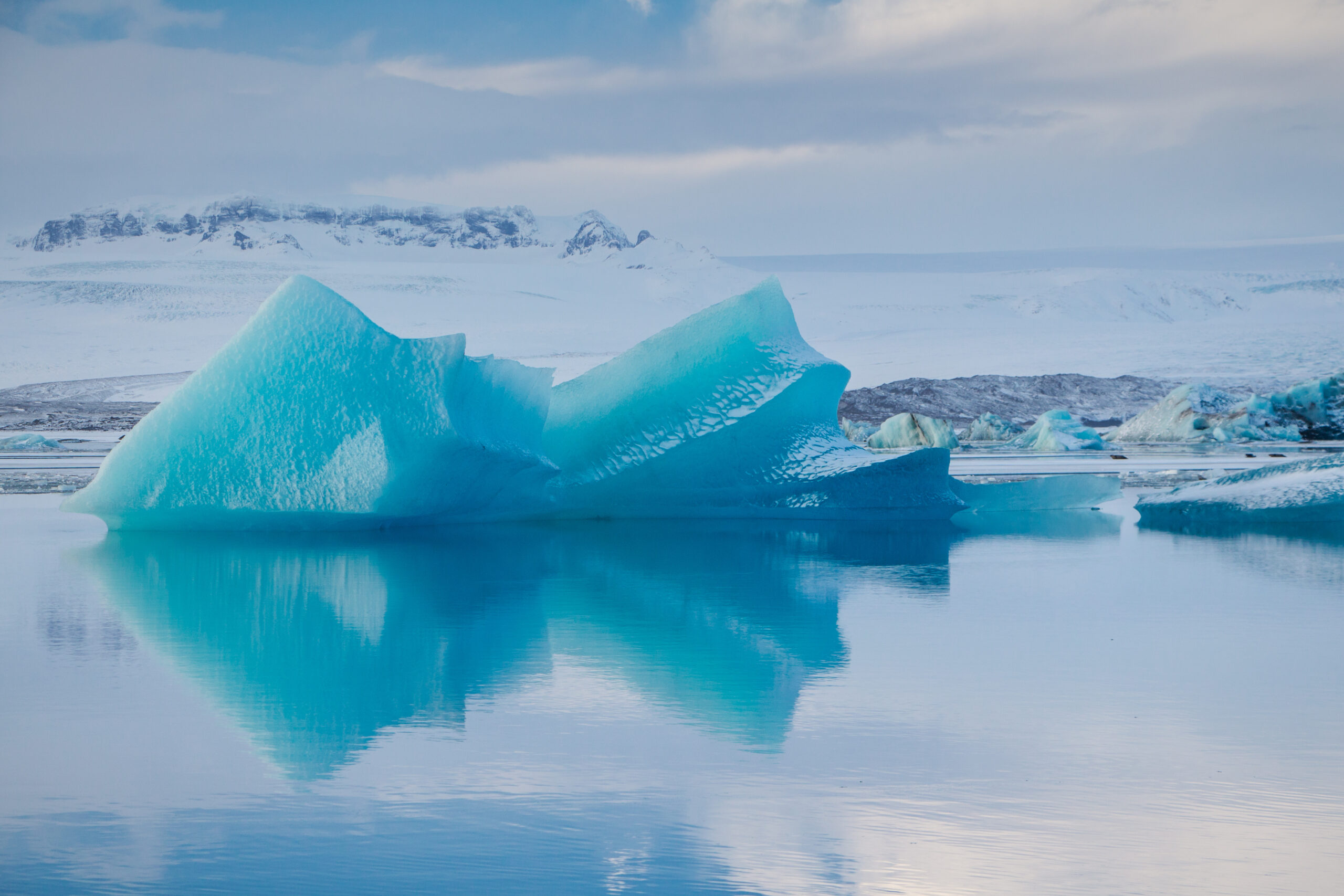
Summer sea-ice extent has declined by roughly 40% since 1979, while maritime activity across the Arctic has increased. The number of unique vessels operating in the region, primarily in connection with Russian exports, rose from 1,298 in 2013 to 1,812 in 2025. Russia invested more than USD 11bn in the Arctic between 2018 and 2024. The region is also estimated to contain 13% of the world’s undiscovered oil and 30% of its undiscovered natural gas.
Together with the NSR’s potential time and fuel savings, these factors are attracting interest. They do not, however, make the route a reliable substitute for established global trade corridors.
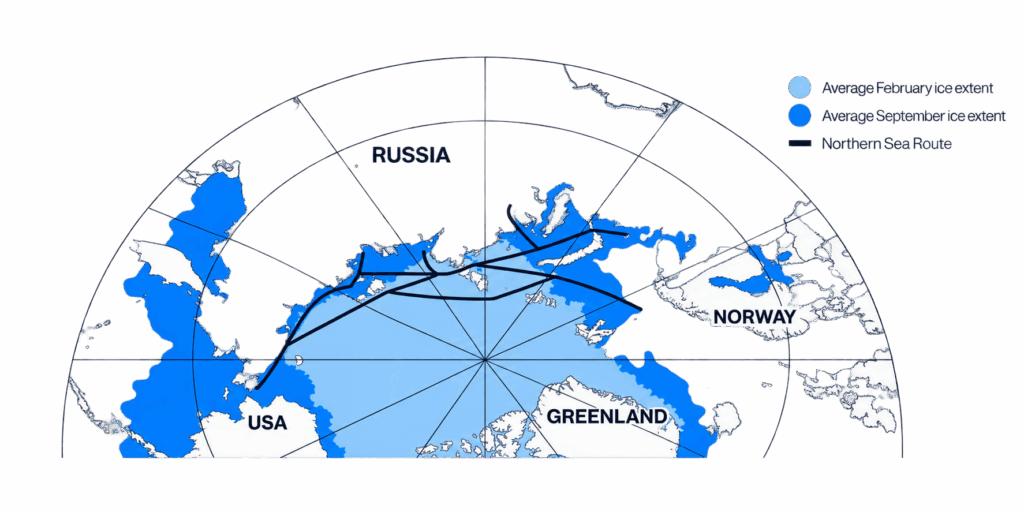
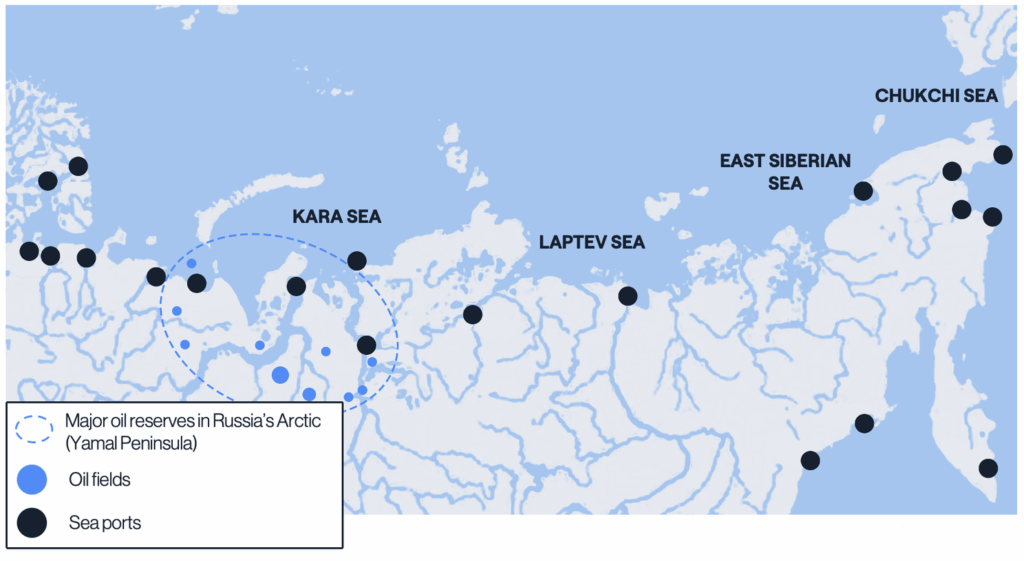
The Northern Sea Route
Launched in 2017, Yamal LNG established a large-scale model for gas development in the Arctic. The project produces 16.5 million tonnes of LNG annually, following an initial investment of more than USD 27bn. Its cargoes are transported by a dedicated fleet of 14 Arc-7 icebreaking carriers, valued at a further USD 5bn, and supported by secured off-take agreements.
Yamal demonstrates that Arctic production and shipping can work at scale when the production site, port, fleet and buyers are aligned. Replicating that model remains difficult: Arctic LNG 2, intended as its successor, encountered significant challenges, compounded by US sanctions imposed on its operator in November 2023.
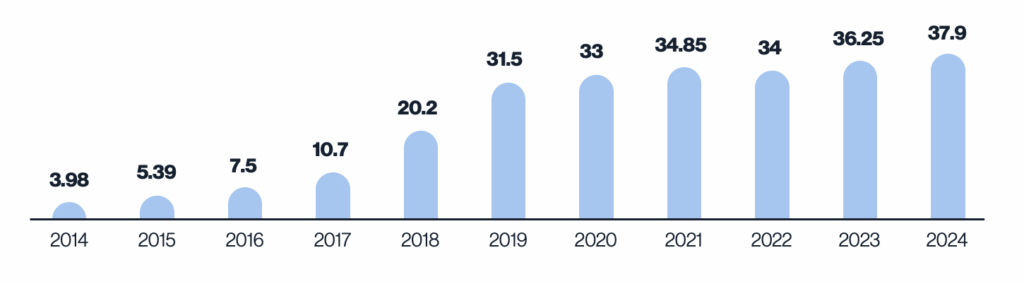
Despite growth, the NSR is still far from an international shipping route. Its total traffic is equivalent to about three weeks of activity in the Suez Canal. In 2025, traffic reached 37.02 Mt, but international transit represented only 3.2 Mt, while containerised cargo made up less than 1% of total volumes.
The route has become a strategic priority for Russia and remains principally a corridor for Russian hydrocarbon exports. Its development is also shaped by intensifying geopolitical competition: Russia is tightening its control, China is positioning itself as a “near-Arctic state”, and the United States and NATO are increasing their presence.
Seasonality, unpredictable weather and limited rescue capacity add operational risk; environmental exposure, contested governance and security concerns create further challenges. Reliable access to specialised vessels and infrastructure remains essential.
NSR freight volumes from 2014 to 2024 (million tonnes)
Restrictions on Russian LNG imports are changing the outlook for existing supply routes. Restrictions on short-term contracts took effect in April 2026, with those covering long-term contracts due to follow from January 2027. This is prompting a shift away from European markets towards Asia.
For Yamal, the NSR provides a shorter route to Asian markets than the Suez alternative; higher LNG profitability also strengthens the commercial rationale for that pivot.
A Declining sea ice, rising Arctic activity, Yamal LNG’s track record and Russian investment have increased the NSR’s relevance to infrastructure and energy players. Significant development is still needed before it can serve international trade at scale.
Ports, ice-class vessels and supporting infrastructure require further investment to improve the reliability and economics of Arctic flows. Geopolitical tensions, regulation, and environmental and operational risks will also remain central considerations. The NSR is therefore an important corridor to follow as its infrastructure and commercial role evolve.
Strategic infrastructure and energy assets along the Northern Sea Route
Eight International supports maritime-sector players across their projects, from financing structures and public tenders to port-practice benchmarking and investment-needs assessments. Our teams also provide financial and tax due diligence, valuation and modelling to help clients evaluate a project’s commercial potential, risks and financial viability.
Download the full report to learn more.


Please let us know if you have a question, want to leave a
comment, or need further information on Eight International